
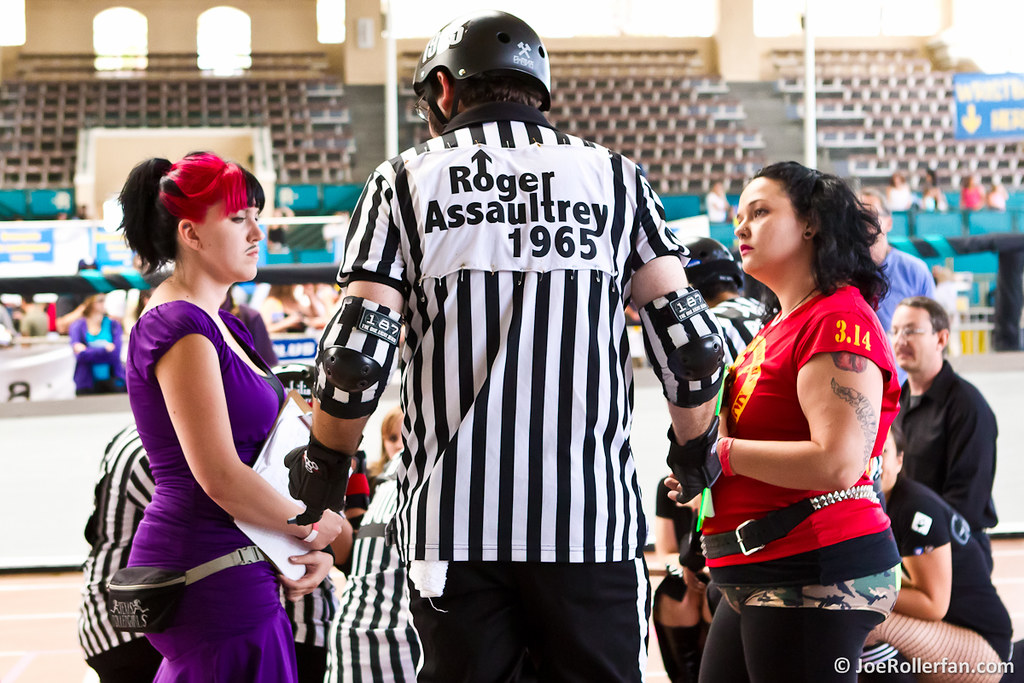
“Hey REF! Where’s the call!? She got all 4 points, not 3! I need an Official Review on that!”
Most referees have heard something like this before. If you’re aspiring to be a Head Referee or you’ve had an Official Review situation that didn’t go exactly as you expected, this guide will help you prepare for your next one. Coaches and Captains, there are lessons for you in here as well. The better you know the Official Review process, the smoother and better it can go for you.
The Rules: Section 1.3.2
From the most current version of WFTDA’s The Rules of Flat Track Roller Derby at the time of publication:
“Each team begins the period with one Official Review which they may use during that period. An Official Review is a formal request made by a team’s Captain or Designated Alternate for Officials to review a specific officiating decision. The only officiating decisions that can be the subject of an Official Review are those made during the prior Jam, or during the lineup time preceding the prior Jam. The Head Referee investigates the review with other Officials, and uses the information gathered to render a decision on the item under review, as well as related decisions. The Head Referee then announces their findings and any changes that result from the review to both teams’ representatives. This decision is final and not reviewable.
If the Head Referee determines that an officiating error was made in relation to the situation under review, the team will retain the privilege to call an additional review later in the same period. The review can be retained in this manner only once per period.
A team may also elect to use their Official Review as a Team Timeout. In this case, the review will not be retained. Penalized Captains or Designated Alternates cannot request an Official Review.
Official Reviews (whether unused or retained) are not carried forward to the subsequent period.”
Anatomy of an Official Review
1. An Official Review is requested, and the clock is stopped
2. Head Referee assembles team representatives (and officials)
3. Head Referee hears the request for the review of an officiating decision
4. Head Referee hears accounts from Officials
5. Head Referee makes ruling
6. Head Referee reports ruling to team representatives, and then if applicable to the audience
Let’s go through the process step by step:
1. Official Review is requested, and the clock is stopped
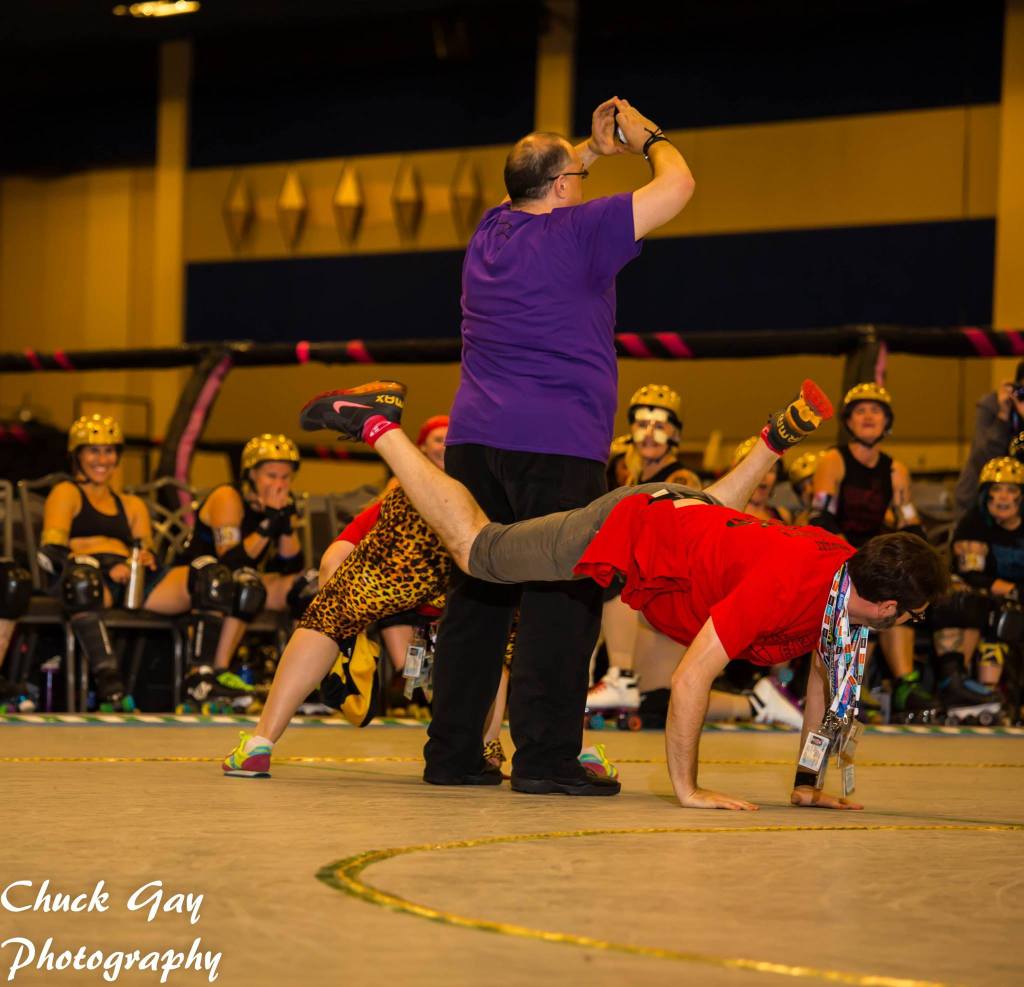
The previous jam just ended. You’re starting your pre-jam routine when you see the telltale “O” hand signal above the Captain or Alternate’s head: It’s an Official Review. The first thing you do is let your Jam Timer know to call an official timeout, so the clock stops as soon as possible (if they haven’t done so already). Confirm with your Jam Timer that it’s an Official Review and for which team so they can cascade that information to the Scoreboard Operator while you gather Officials for the review.
2. HR assembles team representatives (and Officials)
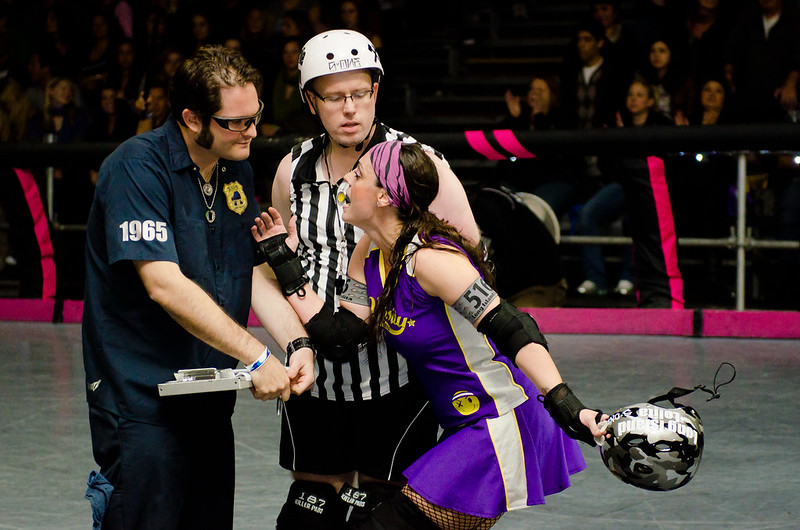
Now that everyone knows that it’s an Official Review, assemble the team representatives infield near the officials crew.
Variation: confer with the team representatives separately from the officials; especially helpful in situations where team representatives are targeting individual officials while presenting their case.
3. HR hears the request for the review of an officiating decision
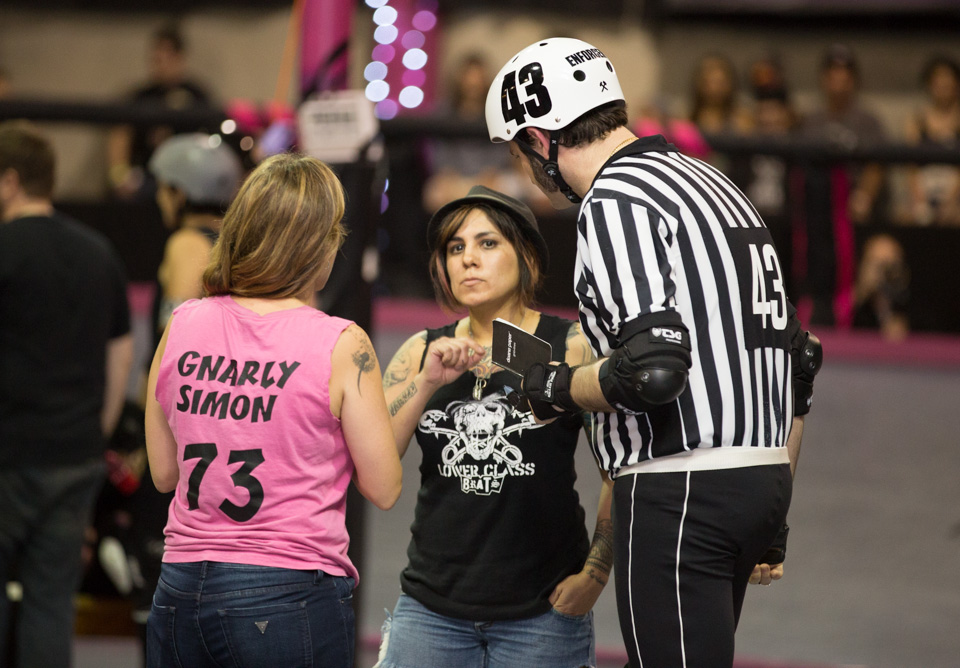
Address the Captain/Alternate who requested the Official Review and ask them to state their case. While you’re listening to the request, you’re also confirming that the Official Review concerns matters in the previous jam or during the previous jam’s lineup time. Finally, if your officials are joining you at the Official Review they should refrain from any crosstalk or response to the team representatives. Before you adjourn to discuss with your officials, repeat the requested review back to the team rep to confirm their request and also ask your crew if they understand the nature of the Official Review as well. Taking notes in a small notebook (you have a small Head Referee notebook for in-game, right?) at this stage is a great way to ensure you have the details of the Official Review, and so you can circle back and address the team representative’s review as it was presented.
4. HR hears accounts from Officials
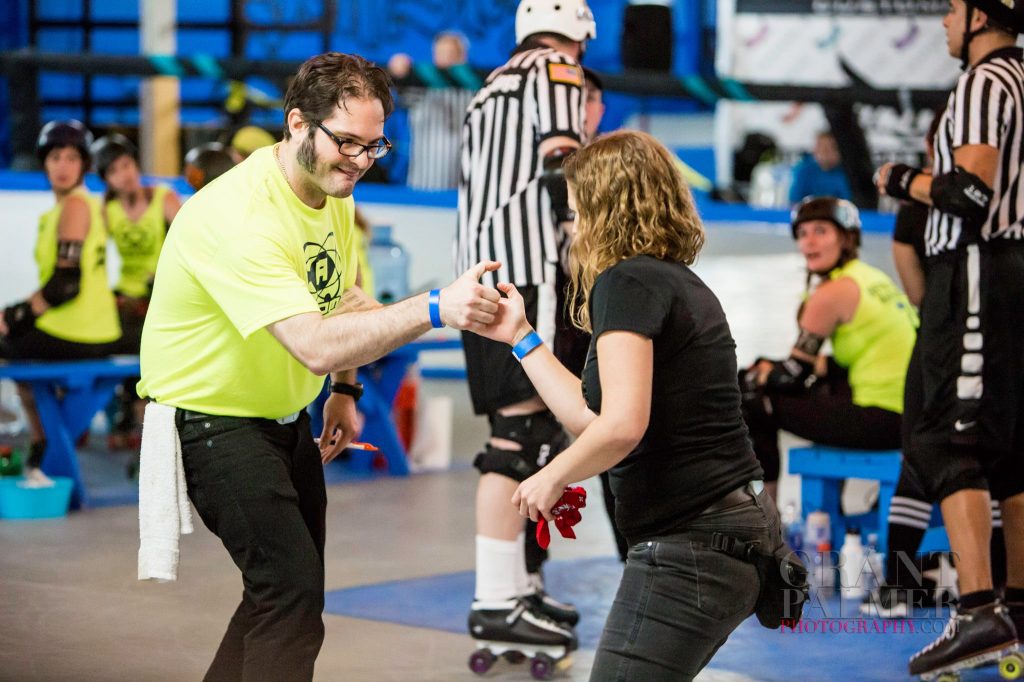
Once you’ve heard the account of the Official Review, gather the appropriate officials separately from the team representatives to hear their accounts as they relate to the Official Review. If skaters remain on the track during the Official Review, then it’s appropriate to ask a skating official who didn’t have eyes on the matter being reviewed to keep eyes on the track during this conference.
Gather your Officials in an area opposite of the Captains and Alternates. It’s helpful to keep these groups separate so cross talk between them doesn’t start. As the HR, you’re mediating the challenge based on the facts available to you and any account of the incident that you have from your fellow Officials to get the call right. You’re also charged with handling the issue expeditiously, so stick to the facts and curtail any extra conversation as best you can to get the game going again as quickly as possible. That said, make sure that you respond to any questions of fact that the representative requesting the Official Review has made so you’re armed with an answer for them when you return to confer with them.
Take notes of the accounts so you can relay as detailed an account as possible, using skater colors and numbers as much as possible when referring to skaters involved in the actions. Above all, ensure that your Officials’ accounts are backed by 100% certainty of the beginning, middle, and end of the facts being reviewed as well as the relevant impact and outcome of the action you’re reviewing.
5. HR makes ruling
Once you have the facts from both sides, it’s time to make your ruling. We recommend discussing your ruling while still huddled with your Officials in the event there’s anything they need to add to their account, and so they’re informed of the outcome. If you’re unsure about any part of the ruling, this is also your chance to double-check your ruling with your fellow Officials. This is also a chance for you to practice delivering your ruling to the huddle before returning to the team representatives.
If uncertainty persists in your conference, as a last resort, refer to the rules. In extreme cases of doubt, it’s better to take a minute and check the rules on your mobile device discretely than make an incorrect call, but not to the extent that it’s slowing down the flow of the game.
6. HR reports ruling to team representatives (and audience if necessary)
Next, return to the team representatives and deliver your ruling, informing them if they retain their Official Review or not depending on the outcome, and then make your announcement to the audience if applicable. At this point, no further arguments should be heard, though a savvy representative may still try. This component of the Official Review is probably the toughest as this is when a ruling may result in a team representative getting fired up if the Official Review doesn’t go their way, or when shrewd managers will try to game the rules against you if they think they can.

Official Review Scenarios & Special Situations
Not all Official Reviews are created equal. Let’s take a look at a few different scenarios and how you might handle them.
Safety/Official Review as a Timeout – Sometimes a Captain or Alternate will signal for an Official Review to get your attention as HR for a reason other than a formal Official Review. The procedure for requesting an Official Review means that play has stopped and an official time out has been called. Captains have the opportunity to speak with you without getting charged for a time out before the game, at quarter breaks, official time outs, and at halftime. That said, if you’ve stopped the clock for a signaled Official Review, but the Captain or Alternate changes their mind or has another agenda, the team will use that Official Review period as a 60 second Team timeout, per section 1.3.2.
Captains agree – Every once in a while the two captains involved in an Official Review might agree on the dispute, even if it’s to the detriment of one of the teams in agreement. While this is unusual, it changes nothing about the Official Review process. Proceed with getting the account from the referees and making your ruling. Just because the teams agree on what they believe the outcome should be, your job is to gather information and make the best ruling you can within the guidelines of the rules.

Manager games your ruling – Occasionally you’ll encounter a manager or coach who is rules savvy. They might be an ex-skater, an ex-Official, or just have a good head for the game and a strong grasp of the rules. Beware of shrewd managers taking your ruling and using it to apply a different outcome than the one you’ve described in your ruling. This is dangerous ground, because if you’re not confident in your ruling and backed by the rules, you could end up impacting the game outside of the scope of the rules. This tactic is especially important to be aware of because a Captain or Alternate might try to squeeze two challenges into one stoppage of play. When in doubt, separate yourself from the manager, review the rules or consult with your crew, and return to them to assert your ruling. Cite the rules if you have to, but a calm assertion of your authority is all you’re required to do. As a last resort, you can always signal to the Jam Timer to end the timeout and proceed with the game. The team representatives know what that rolling whistle means.
Hot tempers – Team representatives may get very animated during the game and especially when the outcome of an Official Review doesn’t go their way. These managers may yell, blame you for their loss (or past losses), or throw their lineup to the ground in disgust. Always keep a cool head in these situations and never meet the intensity level of the hot-tempered manager or coach. Your calm demeanor compared to their fury will quickly evidence how ridiculous they’re acting to their team and spectators alike. When I know that I’m about to HR for a particularly hot tempered manager, I have a little trick I like to keep in my back pocket should they boil over and lose their temper: their real name. In the event that someone is yelling at me, and I’ve already tried to reply to them calmly, my last ditch effort before issuing any Insubordination penalties or just ending the timeout is to address them by their government name. Maybe it’ll work or maybe not, but if I were yelling and someone said, “John. This is a game and we need to communicate calmly,” I’d definitely take a second to get some perspective.
Final Notes
Remain calm, because cooler heads will prevail. Break down the Official Review into bite sized pieces so that even when the crowd is going wild and the adrenaline of the game is pumping, you’ll remain calm, gather fellow Official’s accounts, and make the best ruling you can. You’ve got this!

Activity: Roleplaying Scenarios
For each scenario, one volunteer acts as the HR and one volunteer acts as a Captain issuing the one of the scripted “Official Reviews” listed below. The rest of your group (at least one other person) acts as the crew of Officials staffed in the game offering a fictional account of what they observed (or didn’t observe) during the previous jam. Based on the information available, the Head Referee makes their ruling.
Start each Scenario with the Captain signaling the Official Review signal and end it with the HR signaling the JT to practice each step of the Official Review process. Note: all of these scenarios are based on actually roller derby games that we’ve either Coached or Officiated.
Scenario #1: “The opposing Jammer started the jam, scored 4 points, and called off the jam successfully with the helmet cover inside out, showing no visible stars. Their Jam Ref treated the jammer as if she was legal throughout the jam, so I’d like those 4 points that were awarded in error corrected to zero, and she should also get an illegal procedure for the illegal call off too.”
Scenario #2: “The opposing jammer lost their helmet cover during the second scoring pass after passing two skaters and the Jam Ref reported 4 points for that pass. I’d like the opposing team’s scoring in the previous jam reviewed.”
Scenario #3: “My jammer was called for a cut on an out of play skater. The Front Pack Ref was showing the OOP hand signal, but the Jam Ref still called it a cut. I’d like that call reviewed.”
Scenario #4: “My jammer called off the jam after passing everyone in the engagement zone, leaving two opposing blockers Out of Play way out in the front of the engagement zone. The Jam Ref only awarded 2 points, so I’d like the points for the out of play skaters as well.”
Scenario #5: For this scenario, add a volunteer acting as the opposing Captain who agrees with the Captain requesting the review – “My blocker was called on a Skating out of Bounds penalty, but they were contacted before they stepped out, so I’d like to request a review of that penalty.”
Scenario #6: “Two jams ago, the opposing jammer was issued a Failure to Yield, they did not yield, and no penalty was issued. I’d like that penalty issued, and the jammer put in the box to start the next jam.”
Scenario #7: “When are you going to start calling a fair fucking game?” (Non-challenge, Possible Unsporting Conduct/Misconduct)
Scenario #8: Act like the worst version of the loudmouth coach. Lobby for 4 points instead of the 3 awarded. (temper tantrum, clipboard throw, etc)
Scenario #9: “I want a review on my jammer’s cut. The ref called it way after they supposedly re-entered and their hand signal was barely visible. There’s no way the Official was certain about that call, so I want it gone.”
Scenario #10: “We got called for Destroying the Pack, but I want to know why the other team also didn’t get one. They were making no effort whatsoever.”
 Team Roll With It